Popular searches: KB Main Page, AI Chat, Widgets
Trial / Evidentiary Hearing Costs & Requesting Funds
MyCase Letter to Clients re: trial funds: FAM – Letter to CLIENT re trial costs (May 2026)
(Quick Note – In this article, the term “trial” will be used to describe both trial and evidentiary hearing since they are essentially the same thing. There may be changes you need to make in the template to indicate that the hearing is an evidentiary hearing rather than a trial)
When to request trial funds
It is crucial to request trial funds as soon as possible, ideally as soon as the trial date gets schedule. While most cases will never go to trial, or even get close to trial, it is important for clients to realize the cost of trial while they are negotiating the case as it should help remind them the advantages of compromising as compared to paying well over $10,000 for trial.
How much will trial cost
There is a template letter in MyCase (FAM – Letter to CLIENT re trial costs) that should be sent to the clients immediately upon scheduling trial. The trial letter lays out the different steps necessary when there is a trial scheduled. The letter then has a fillable table for each of those areas so it can calculate the cost depending on the hourly rate and number of hours each area is estimated to take. The table is already completed with a general idea of how many hours each task will take based on a one day trial, but each case is very different and specific, so ask the attorney for specifics. See below for screenshot of the table and explanation of each line item:
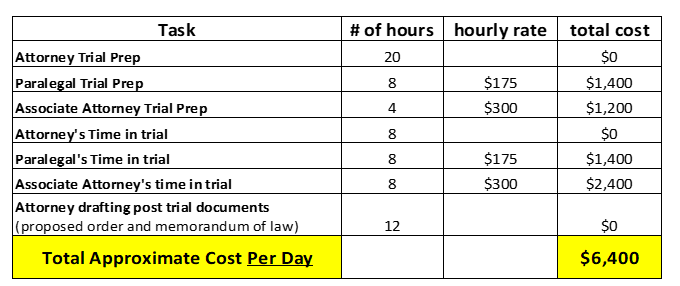
- “Attorney Trial Prep” – 20 is what is listed. This is based on the assumption that the attorney will need 2.5 hours of prep for each hour of trial (There is reference to this in the actual letter part of the trial where it says “The general rule is that it takes 2-3 hours of preparation for every hour of trial.”) You can edit this if directed to do so by the attorney, but I would caution you that preparing for trial ALWAYS takes more time than you would anticipate. Unless otherwise told, leave this as is. You will need to enter the hourly rate depending on your attorney. Always reference back to the billing details or retainer agreement to confirm you input the correct hourly rate.
- “Paralegal Trial Prep” – 8 hours is what is listed. This can be adjusted as necessary, but again, I would say it’s unlikely it would be less than this. If there is no associate attorney who is helping with trial prep, I would say it’s likely this number would go up. Consider that the paralegal will be the one primarily doing all the exhibits and that is very time consuming. The default rate is $175, but old cases may still be at $160. Always reference back to the billing details or retainer agreement to confirm you input the correct hourly rate.
- “Associate Attorney Trial Prep” – 4 Hours is what is listed. If there is no associate attorney helping prep, you can delete this entirely.
- “Attorney’s Time in Trial” 8 hours is what is listed. Again, this shouldn’t be changed UNLESS trial is scheduled for something less than 8 hours. You’ll have to enter the correct hourly rate.
- “Paralegal’s Time in Trial” 8 hours is what is listed. This shouldn’t be changed, but verify the rate. If a paralegal will not be attending trial, this can be deleted.
- “Associate Attorney’s time in Trial” 8 hours is what is listed. If there is not going to be an associate attorney going to trial, then you’d for sure want to verify whether the paralegal is going to trial. If this doesn’t apply, delete it.
- “Attorney drafting post trial documents” 12 hours is what is listed and is based off previous trials. Drafting proposed orders and memos of law is time consuming, especially on cases that involve both children and finances. Don’t change this unless told to do so by your attorney.
TOTAL APPROXIMATE COST PER DAY – This will be the total from everything you have entered. Again, this is PER DAY. Yes, trial is expensive. I think people consistently underestimate how expensive trial is. I am hoping to go back through mycase in the next few weeks and pull actual costs of trials from some of the trials we’ve done in the past few years.
How much should we request for trial
Again, this varies. However, realistically, we want approximately 80% of the estimated trial cost up front (and the more the better). We should be requesting $15,000 per day. However, always verify this with the attorney. The goal is to get a significant portion of the trial costs before trial so the invoices following trial are not substantial and are more likely to be paid. Once we have done the trial and submitted the documents, clients have no motivation to pay us any additional funds and many MANY times we’ve been left with a client who has a significant balance after trial and just never pays it. Yes, there is collections and conciliation court, but we want to avoid all of that.
When should the trial funds be due?
Currently, the letter says six – eight weeks before trial. Six weeks should be the absolute latest date we ever use. If we get any closer to trial than that, it becomes an ethical issue for us to withdraw and we could get stuck doing the trial without getting paid at all. If you are sending out your letters early enough, then eight weeks is a better time frame to request funds.
What if the case is going to settle?
It doesn’t matter. It’s better for the clients to know the cost well ahead of time and settle the case then to be told last minute they owe us $15,000 for trial. It doesn’t matter if they swear they aren’t taking it to trial, or if they say they don’t have the money, or they say an agreement has already been reached. If there is a trial date scheduled, then there should be a trial letter sent to a client and request for funds. And again, knowing how much trial costs may help motivate clients to settle.
Not everyone can afford trial and that’s just the reality of the work we do. The sooner they can understand the true costs of trial the sooner clients can do things like attempt to get money from family, get credit cards, withdraw money from 401k, take out loans, etc. Or, if they truly can’t afford it, then it means the sooner they can be having very frank discussions with the attorneys about what their options are in terms of either trying to resolve the case, trying to handle the trial pro-se, or something else.
What to do when we get a trial date and how to request funds
- Put the trial date on the calendar:
- The title should be all uppercase
- Always book from 8am to 5pm unless otherwise indicates in the notice of hearing.
- Include details regarding who the judge is, what courtroom the hearing is (if there are multiple court rooms)
- Be aware the client can see the description.
- Select only our client under contacts and leads (Click BOTH Share and Attend)
- Select the attorney under staff (Click BOTH Share and Attend) and any associate attorney or paralegal that will also be attending.
- Open the “Letter to Client re trial costs” template from mycase (always use the templates for most up to date versions.
- Fill in the necessary information in the letter (date, case title, who the letter is to, date of trial, number of hours, hourly rate, amount being requested, due date for funds). Don’t forget to also read the entire letter as a whole, because there may be pieces of it that don’t apply to your case or your attorney, so edit/personalize as necessary.
- Send letter to attorney to review/approve.
- Once approved, upload and share the letter with client on mycase. Try to name the document something that stands out like “Trial Cost Letter for John’s Review”
- Send a message or text to client:
- I’ve just uploaded to mycase a letter regarding trial, including information on preparation and costs. Our goal is always to resolve cases without going to trial, while still getting the best possible outcome for our client. While the vast majority of cases settle prior to trial, there are circumstances where the parties are unable to come to an agreement and a trial becomes necessary. In those cases, we want our clients to be well aware of the costs long in advance. Please review this document closely and let me know if you have any questions. Additionally, please know that Amber in our finance department will be in contact with you regarding the funds requested for trial.
- Send finance an email: “hey (finance manager’s name), can you send a request for funds in the John Doe case? It will be $15,000 for trial and will be due on March 13, 2023. I just shared with John the trial letter so he should know this is coming” (See Family Cases – Request for Funds – K|H Law Wiki (theintervenors.com) )
- Finance will send the request for funds and set a task to watch for payment and work on obtaining payment.
- Any updates you have regarding the trial (like stip drafted, close to settlement, no way it’s gonna settle, going to trial) should be updated in the task that finance has created.
- If the client calls/messages/texts with complaints about how they aren’t going to trial, they are going to settle, that is so far away, why are you requesting trial funds I thought you were going to help me resolve this, assure them that we are absolutely going to do everything we can to get them the outcome they want without having to go to trial – that is our top priority. However, in the event that an agreement can’t be reached or they decide they want to take the matter to trial, we want them to have plenty of time to financially prepare for the cost of trial as we know it is a significant expense.
- If the date that funds are due comes and the client has not yet paid, immediately discuss with the attorney and ask if you should draft withdrawal documents.